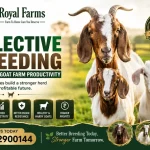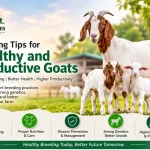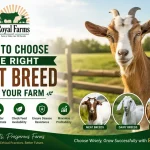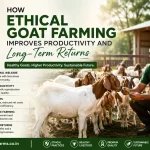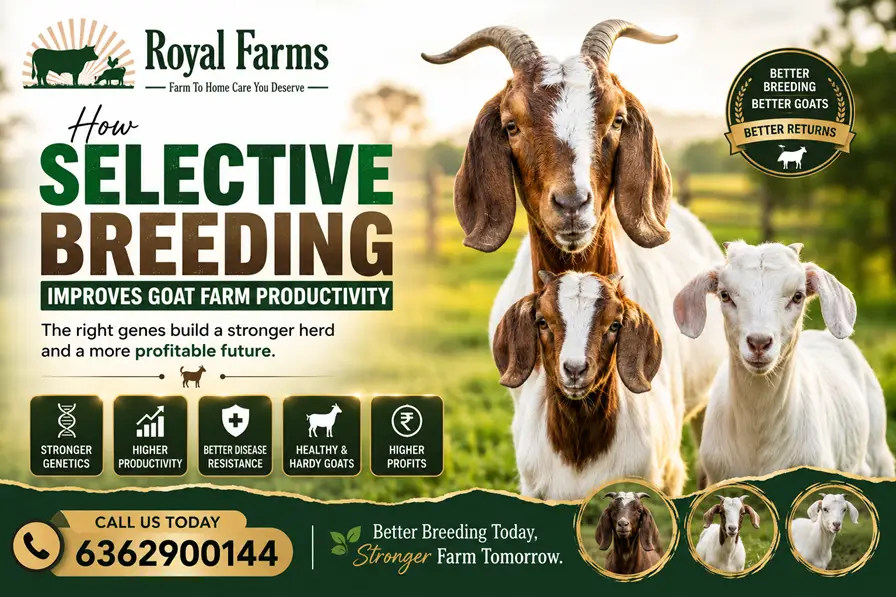
Goat farming is becoming an increasingly important livestock business in Karnataka. From small farmers to professionally managed commercial farms, many people are exploring goat farming as a long-term agricultural opportunity. However, increasing the number of goats alone does not guarantee better productivity or profitability.
A productive goat farm begins with a strong and healthy herd. This is where selective breeding can make a significant difference.
Selective breeding involves choosing goats with desirable characteristics and using them strategically for reproduction. Over time, this approach can help improve herd quality, growth potential, reproductive performance, and overall farm efficiency.
For goat farmers in Karnataka, combining selective breeding with proper nutrition, healthcare, housing, and professional management can create a stronger foundation for sustainable livestock farming.
What Is Selective Breeding in Goat Farming?
Table of Contents
ToggleSelective breeding is a planned approach to reproduction in which farmers choose specific male and female goats based on desirable characteristics.
Instead of allowing all animals to breed without a clear plan, farmers identify goats that demonstrate valuable traits such as:
- Healthy body development
- Good growth potential
- Strong reproductive performance
- Good body structure
- Adaptability to local conditions
- Healthy offspring
- Good feed utilization
- Strong overall health
The selected animals are then used as breeding stock to help pass desirable characteristics to future generations.
The process takes time, but consistent selection can gradually improve the overall quality of a herd.
Why Is Selective Breeding Important for Goat Farms in Karnataka?
Karnataka has diverse climatic and agricultural conditions. Goat farms may operate under different feeding systems, housing arrangements, and environmental conditions across the state.
Because of this, farmers need animals that can perform well under their specific farm conditions.
Selective breeding can help farmers focus on goats that demonstrate good performance within their existing environment rather than selecting animals based only on appearance.
For example, a goat that maintains good body condition, grows consistently, remains healthy, and performs well reproductively may be a better breeding candidate for a particular farm.
1. Improve Growth and Herd Quality
Growth performance is an important factor for commercial goat farming.
Farmers can monitor the development of young goats and identify animals that consistently show good growth and body development. These animals can then be considered for future breeding.
Over successive generations, careful selection may help improve the growth potential of the herd.
However, genetics is only one part of the equation. Proper nutrition, clean water, healthcare, housing, and farm management are equally important for allowing animals to reach their potential.
2. Improve Reproductive Efficiency
Reproductive performance directly affects herd expansion.
A healthy breeding female that consistently produces healthy kids can make a valuable contribution to a goat farm. Similarly, selecting healthy and productive breeding bucks is important because one buck may contribute genetically to many offspring.
Farmers should monitor:
- Breeding history
- Kidding performance
- Number of kids produced
- Kid survival
- Recovery between pregnancies
- Overall health
- Offspring performance
These records can help identify animals that are suitable for continued breeding.
3. Select Breeding Animals Based on Performance
One of the biggest advantages of selective breeding is that decisions can be based on actual performance rather than appearance alone.
A goat may have an attractive appearance but may not necessarily be the best breeding animal.
Farmers should consider multiple factors, including:
Health + Growth + Reproduction + Body Structure + Adaptability + Offspring Performance
Using several criteria creates a more balanced breeding strategy.
4. Build a Herd Better Suited to Karnataka
Environmental adaptability is particularly important for livestock farming.
Goats selected for breeding should be able to perform well under the farm’s local climate, feeding system, housing conditions, and management practices.
For farms in Karnataka, farmers can consider how animals respond to seasonal changes, available fodder, temperature, water availability, and the overall farm environment.
The goal is to develop a herd that is not only genetically promising but also practical to manage under local conditions.
5. Improve the Quality of Future Generations
Selective breeding is a long-term investment in the future of the herd.
When farmers consistently select healthy and productive animals for reproduction, undesirable traits can gradually become less common while desirable traits become more prominent.
This can help create a more consistent herd over multiple generations.
However, farmers should avoid excessive breeding of closely related animals. Maintaining proper lineage records and introducing suitable unrelated breeding stock when necessary can help support genetic diversity.
6. Maintain Accurate Breeding Records
Record keeping is essential for an effective selective breeding programme.
Each breeding animal should have an identification method, with important information recorded throughout its productive life.
Useful records include:
- Date of birth
- Parentage
- Growth measurements
- Health history
- Breeding dates
- Kidding history
- Number of offspring
- Offspring performance
- Vaccination and healthcare records
Good records make it easier to identify the strongest breeding lines and make informed decisions.
7. Combine Genetics With Good Farm Management
Selective breeding cannot replace proper goat management.
Even animals with strong genetic potential need appropriate care to perform well.
A productive goat farm should combine breeding programmes with:
- Balanced nutrition
- Clean drinking water
- Suitable housing
- Regular health monitoring
- Preventive healthcare
- Parasite management
- Proper hygiene
- Adequate space
- Professional breeding management
When genetics and management work together, farmers can create better conditions for long-term herd productivity.
How Royal Farms Supports Modern Goat Farming in Karnataka
Royal Farms is an agri-livestock company headquartered in Bengaluru, Karnataka, with a focus on professionally managed livestock operations. Its approach includes breeding and genetics, housing, feeding and nutrition, healthcare management, and operational planning.
The company’s sheep and goat farming operations focus on breeding and growth, with breed selection and management practices tailored to farming objectives and regional requirements.
For farmers and investors interested in organized livestock farming, professional management can help bring greater structure to breeding, animal care, and day-to-day farm operations.
What Makes Selective Breeding a Long-Term Strategy?
Selective breeding should not be viewed as a quick method for increasing farm returns. Genetic improvement takes time and requires consistent selection over multiple generations.
Farmers should regularly review herd performance and adjust their breeding decisions according to results.
A successful programme focuses on gradual improvement rather than expecting immediate changes.
The most important principle is simple: breed the best animals for the qualities that matter most to your farming goals.
Conclusion
Selective breeding can play an important role in improving goat farm productivity in Karnataka. By carefully choosing healthy and productive breeding animals, maintaining accurate records, preventing unnecessary inbreeding, and monitoring offspring performance, farmers can gradually develop a stronger and more productive herd.
However, genetics alone cannot guarantee success. Selective breeding should be combined with proper nutrition, healthcare, housing, hygiene, and professional farm management.
For modern goat farming in Karnataka, the focus should be on quality, consistency, animal health, and long-term herd improvement rather than simply increasing the number of animals.
With a well-planned breeding strategy and responsible livestock management, goat farmers can build a healthier herd and create a stronger foundation for sustainable farm productivity.
Frequently Asked Questions
1. What is selective breeding in goat farming?
Selective breeding is the process of choosing specific male and female goats with desirable traits for reproduction. The objective is to gradually improve the quality and productivity of the herd over successive generations.
2. How can selective breeding improve goat farm productivity?
Selective breeding can help improve desirable characteristics such as growth potential, reproductive performance, body structure, adaptability, and overall herd quality when combined with proper nutrition and healthcare.
3. What traits should farmers consider when selecting breeding goats?
Farmers should consider health, growth, reproductive performance, body structure, adaptability, disease history, and the performance of previous offspring when selecting breeding animals.
4. Is selective breeding suitable for goat farms in Karnataka?
Yes. Selective breeding can be adapted to goat farms across Karnataka. Farmers should consider local climate, available feed, housing systems, farming objectives, and market requirements when making breeding decisions.
5. Why are breeding records important in goat farming?
Breeding records help farmers track parentage, growth, health, breeding history, kidding performance, and offspring quality. This information makes it easier to identify productive animals and make better future breeding decisions.
6. Can selective breeding alone increase goat farm profits?
No. Selective breeding is one part of successful goat farming. Profitability also depends on nutrition, animal health, housing, management, breeding efficiency, operating costs, and market conditions. A complete farm management approach is essential for sustainable results.