Poultry farming today is not just about feeding and watering birds. To achieve maximum performance — in terms of health, growth, egg production, and profitability — the farm environment needs precision control. Environment-controlled sheds are transforming poultry operations across India and globally, helping farmers deliver the perfect conditions for their flocks every day, in every season.
In this blog, we’ll explore how environment-controlled poultry sheds work, why they matter, and how they directly improve poultry performance.
What Are Environment-Controlled Poultry Sheds?
Table of Contents
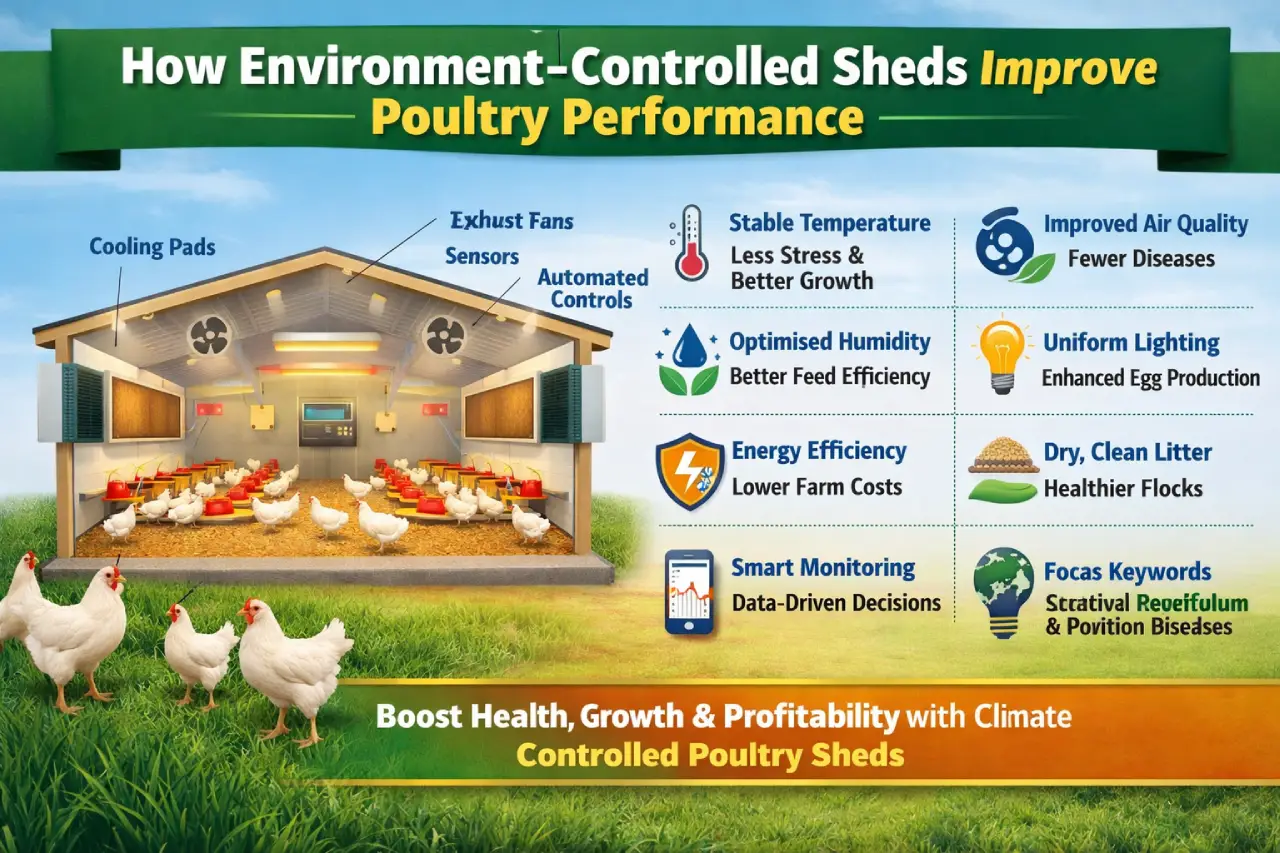
ToggleAn environment-controlled shed uses technology and design to regulate the internal conditions of a poultry house. Instead of relying on natural ventilation or manual adjustments, these sheds automatically manage:
- Temperature
- Humidity
- Air quality
- Airflow
- Light intensity
- Litter moisture
All of this is done through integrated systems like evaporative cooling pads, tunnel ventilation, automated fans, sensors, and controllers.
Why Environment Control Matters in Poultry Farming
Birds are highly sensitive to their surroundings. Unlike humans, they cannot sweat to cool down or shiver efficiently to warm up. Even slight deviations from the “comfort zone” can stress birds, lower immunity, reduce feed intake, and hurt performance.
Here’s how environment-controlled sheds make a difference:
1. Stable Temperature = Healthier Birds
Extreme heat or cold can stress poultry, leading to:
- Reduced feed intake
- Poor weight gain
- Higher mortality
- Lower egg production in layers
Environment-controlled sheds maintain optimum temperature ranges tailored to age and breed. This encourages consistent growth and better physiological performance.
✔ Key Benefit: Reduced heat stress and cold shock
✔ Result: Higher survival rates and uniform growth
2. Improved Air Quality Reduces Diseases
Traditional sheds often have poor ventilation, leading to:
- High ammonia levels
- Dust buildup
- Humid conditions that favour pathogens
With controlled ventilation systems:
- Fresh air is circulated constantly
- Harmful gases are expelled
- Dust levels decrease
- Humidity is optimised
✔ Key Benefit: Stronger respiratory health
✔ Result: Fewer disease outbreaks and lower medication costs
3. Optimised Humidity Boosts Comfort & Feed Efficiency
Humidity directly impacts birds in two ways:
- High Humidity: Birds struggle to cool themselves
- Low Humidity: Respiratory irritation
Smart controllers keep humidity in the ideal range, so birds stay comfortable, eat well, and convert feed more efficiently.
✔ Key Benefit: Better feed conversion ratio (FCR)
✔ Result: More productivity with the same feed input
4. Uniform Lighting Improves Growth & Egg Production
Lighting influences:
- Feeding schedules
- Activity levels
- Hormonal balance (especially in layers)
Automated lighting systems replicate natural day-night cycles. This means:
- Calm flocks
- Better growth patterns
- Improved egg laying consistency
✔ Key Benefit: Controlled light schedules
✔ Result: Enhanced performance without stress
5. Energy & Cost Efficiency for Farmers
Yes — technology has a cost. But environment-controlled sheds are:
- Energy efficient
- Labour saving
- Highly automated
Modern systems use sensors and controllers that adjust settings in real time — reducing wastage and improving economic returns.
✔ Key Benefit: Lower operational cost per bird
✔ Result: Higher profits over time
6. Better Litter Quality = Healthier Flocks
Moisture and airflow control help keep litter dry. Dry litter:
- Reduces pathogenic growth
- Lowers footpad problems
- Improves overall hygiene
✔ Key Benefit: Reduced health issues
✔ Result: Better flock performance and more uniform growth
7. Data-Driven Decisions with Smart Monitoring
Top environment-controlled systems come with:
- Real-time data on temperature, humidity, and airflow
- Alerts for system anomalies
- Historical records for management decisions
This data helps farmers:
- Predict problems early
- Adjust feeding and vaccination schedules
- Optimise production cycles
✔ Key Benefit: Proactive flock management
✔ Result: Higher efficiency and better ROI
Summary: The Big Wins of Environment-Controlled Poultry Sheds
| Benefit | Outcome for Your Farm |
|---|---|
| Stable temperature | Less stress, better weight gain |
| Fresh air circulation | Fewer diseases, lower costs |
| Controlled humidity | Better FCR and comfort |
| Smart lighting | Enhanced growth and egg production |
| Improved litter health | Cleaner, healthier flocks |
| Energy efficiency | Lower costs, higher profits |
| Intelligent monitoring | Data-backed decisions |
Final Thought
Environment-controlled sheds are not a luxury — they are the future of profitable poultry farming. With climate challenges and rising feed costs, creating a consistent and controlled environment for your birds is one of the smartest investments you can make.
By incorporating these systems, poultry farmers can deliver optimal living conditions, reduce stress, enhance growth, and ultimately boost performance and profitability — season after season.